Sunday, July 7, 2024

Instagram: Dogs of Nepal

It feels a bit weird to promote my Instagram on this blog, like I am reaching across decades of social media. Like it is somehow a violation of what should be possible.

Nonetheless, I'd like to make those of you who are not aware, aware of my Instagram page. It can be found here under the handle @dogs.ofnepal. It does, predictably, feature dogs; it also features a lot of landscapes and everyday snippets of Nepali life; and is a collection of photos that I have taken during my service. Please give it a look if it sounds interesting. I post every three days or so there. Here's a peek.


Khukuri

"Hey buwaa," I said. "The khukuri that was used yesterday to slaughter the goat. Whose khukuri was that?" I was referring to the long, thick blade that Birendra used for butchering.

He smiled. "Ours," he said. "Why?"

I told him I wanted to take a picture.

"Oh, you want to know about it? Well..." he said...

and my lesson on the khukuri began.

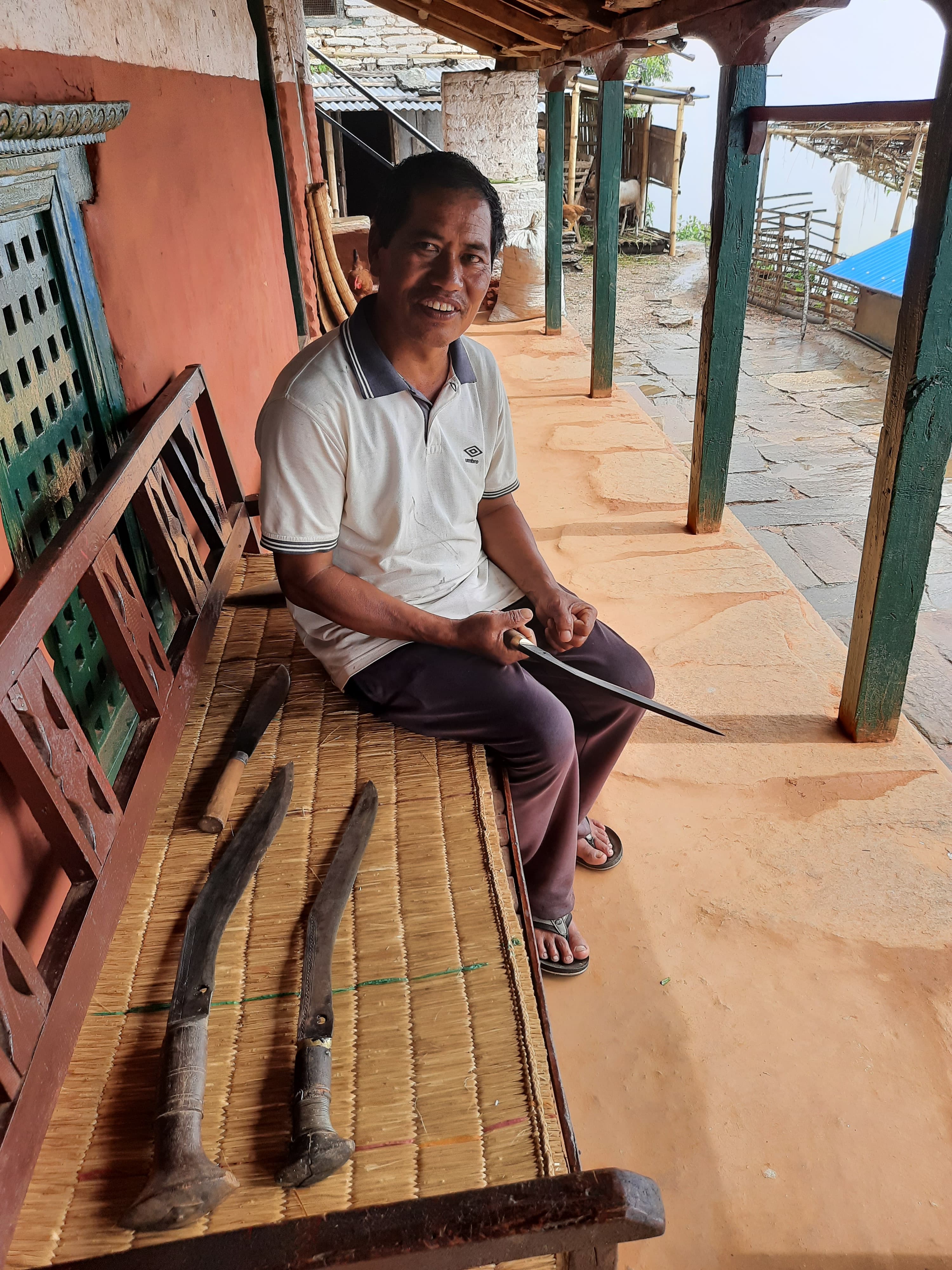
Three khukuri of our household in various sizes - ordered and handcrafted decades ago and still in excellent working condition.

***

The khukuri is a traditional Nepali blade (some may call it a sword, a shortsword, and others a knife). Though it has many uses the sword is most famous as the weapon of choice - and emblem - of the Gorkhas* - Nepali soldiers conscripted into the British and Indian armies. The history of the Gorkhas began in 1815 when they were recruited into the British East India Company following the Anglo-Nepalese War.** They are renowned worldwide to this day for their valor, fearlessness, and ferocity in battle. 

"Did you see the khukuri at our Pokhara house?" buwaa asked me. "It's in the big display case." He was referring to a scabbarded khukuri and pedestal on which it sat in the family's other house in the big city. I recalled seeing it in the past and recognized the installation as a sort of military plaque at the time - but had never taken a close look at it.

A small, sheathed khukuri - for show only. Blades like these are used for dances, parades, and showcasing.

You see, buwaa is a retired Indian army veteran. He served, like many other Nepali, in its Gorkha battalion. His military career lasted about 28 years. Eight years ago he retired from the army and settled back in Nepal, though he still remains a soldier at heart despite the growing distance between then and now.

***

I was squatting on the porch one afternoon, down on one knee, my binoculars trained on a bird perched on a nearby wire. "You remind me of my army days," said buwaa, who was sitting on our porch armchair. "Ask me why. Go on," he said. He walked over, laughing. "We used to have to sit like that while we were on duty -- watching and hiding, like this, right?" He squatted next to me and demonstrated. "And if someone came along we had to pay attention: to what they were wearing, what they had on them, if they had guns, how many people there were, where they were, and where they were going," he explained. "Like if we're here, and they are there" -- crouching on the red clay of the veranda, he drew lines in the dried mud with his finger, lining out the trajectories -- "we had to relay the location, distance and direction to our supervisors." 

We have moments like these all the time. It is apparent to me how proud he is of his identity as a soldier, a Gorkha, a Nepali. His sense of honor, duty, and right and wrong is very strong - this runs in the family. When he talks about his army days he emanates a wistfulness that may only match that of his childhood memories (when he recalls them). There are many stories to tell. But his time in the army was also extremely difficult; brutal; painful; and sometimes painfully boring. Buwaa is ever a practical man, honest, open, and difficult to shy. But I have yet to ask him for any of his more harrowing stories. I wonder if I ever will.

***


Buwaa regaling me with khukuri lore, blades laid bare on the bench.

Buwaa explained the use of the swords as a soldier. "We had to wear our swords at all times on our belt, like this," he said, patting his hip to indicate it hanging down from a belt. "And these ones, like I said --" he took the small knife in his hand "-- are just for show. For display only. But we used them as part of our Gorkha dance." His eyes lit up. "Shall I show you how it went?"

Buwaa stepped back from the porch and onto the mud-and-stone-leveled patio. "Here, I'll show you a little bit." Thus followed a series of dance steps - whirling, brandishing, stomping, and slashing. Proud, disciplined, confident. I could imagine him in line with dozens of other foot soldiers in uniform, their movements in sync, the rapping of their feet echoing in formation. A formidable sight it must have been. After a couple minutes of this buwaa stopped, winded, to catch his breath. "You really sweat a lot," he said. "I can't remember the whole thing anymore."

Of course, khukuri are most famous for their use in battle. But they are an extremely versatile tool that can be used for a variety of utilities:

  • Trailblazing - hacking plants and bushes in the jungle, as a machete.
  • Building - used to cut wood, bamboo, and other materials.
  • Food prep - animal slaughter.
  • Warfare/defense - a deadly weapon.

"You see this?" Buwaa pointed to a notch on one of the large blades a few inches above the hilt. He then pointed to identical notches on the other khukuri he had brought out to show me. Beside the notch a U-shape was carved out of the metal. "These notches - what do you think they are for?"

I suggested it could be for hanging the blade. For example, hanging it on a wall by a nail. "That is true," he said. "We would sometimes hang our blades on the wall, you can hang them by these notches." He paused. "But what it is really meant for is wicking blood."

The blood-wicking notch.

"As you are fighting, and cutting things, and blood is running down the blade, it runs down your hands and arms," he explained. "It gets all slippery and messy. But with this notch the blood drips off the blade instead of getting on your hands." A delicate, but notable, distinction - one that must make all the difference in battle.

These days the khukuri throws a lot of weight around as a symbol of Nepal. You see its likeness on clothing, stationary, and logos everywhere - sometimes in the form of two crossing blades, other times with a crossed blade and its sheath.

A pair of WWII (left) and WWI (right) khukuri crossing***. The image of two crossed khukuri serves as a symbol of the Gorkha warriors -- sometimes, Nepal itself -- and can found on traditional items and keepsakes.

A clip from a Peace Corps Nepal video of Kim wearing a dhaka topi emblazoned with the two-khukuri crossing symbol.

Other types of blades certainly exist in Nepal - but none as charismatic as the khukuri. As buwaa and I were sitting together discussing swords, aamaa had been watching us with some interest and amusement. A few minutes later she sat down with another blade in her hand -- the dao. (This is an Indian blade originating from the ethnic Naga group, as buwaa enthusiastically explained).

 "This was given to me by my older brother," she said, hoisting the blade in her hands. As the story goes, decades past she had needed a knife for household chores. He was in India at the time serving in the Nagarian army, so he bought and sent one to her. Some time later he faced an untimely death while he was in service. She held the blade by the hilt quietly, turning and gazing at it in her hands - no doubt thinking of that time.


Aamaa gazes at the dao that her late brother gave her, reminiscing.

Perhaps khukuri feel as familiar and comforting to buwaa as Nepal itself does. They, the Gorkha, and Nepal have such a strongly defined and intertwined relationship that it would be remiss to separate any one from the others. Whatever becomes of the Gorkha in the future, the khukuri will surely remain a part of Nepal: a blade as venerable as its people.


*Not to be confused with the people who live in the Gorkha district of Nepal.  

**The Gorkhas have a centuries-long military history that is fascinating -- I won't get into details here; though recent political developments have threatened their existence as a branch of the Indian Army.

***From this directory stumbled on of historic khukuri manufacture. Very cool.

Saturday, June 22, 2024

How to Slaughter and Dress a Goat

This post describes animal death and processing in graphic detail and photography.

***

HOW TO SLAUGHTER AND DRESS A GOAT

  1. Obtain a goat
  2. Restrain the goat
  3. Deliver the killing blow
  4. Shave the carcass
  5. Rub the carcass down with turmeric paste
  6. Process the head & organs
  7. Chop the remaining body into pieces
  8. Divvy up equal portions of meat for yourself and other family members
  9. Cook and enjoy


Obtain a goat

Whether home-grown or bought, a goat is required for this operation. So get yourself a goat!

Upon hearing a cacophony of goat yelling, I went downstairs and was surprised to see a new kid tied to a post at our goat shed, two or three months old by my estimation. We had lost one of our kids in days past. It ingested something toxic while grazing in the fields and forests, we think. Nonetheless, I was surprised that my host parents would want to pay for the responsibility of another mouth to feed and care for. “Four goats isn’t enough for us?” I asked buwaa. He was at first confused by my question - it took a moment for him to understand what I meant. “Oh – we’re eating this one,” he said. This dealt another surprise to me as goats (and goat meat) are quite expensive here. There appeared to be no particular occasion for the decision, as far as I could tell; I supposed the opportunity to buy and slaughter a goat simply presented itself on this particular day and they took it.
 

Restrain the goat

Restrain the goat on level ground with hands and ropes. Keep the goat as still as possible with its neck held up and stretched taught. Place a log underneath the goat’s body to encourage it to splay its legs (optional).

Thinking the slaughter would not happen for some period of time, I had returned to my room when I suddenly noticed the poignant absence of the kid’s bleating outside my window. The dai were hauling it off to be killed. Not wanting to miss the activity, I rushed outside in my sandals and followed them to the side of our uncle’s house where they had begun setting up.


I did not have my phone on me at time of slaughter, so here is my drawn recreation, complete with poised khukuri and target area.


Deliver the killing blow

Take a wide, firm and confident stance. Deliver the killing blow to the base of the neck with a forceful chop of a large, strong blade, such as a khukuri.

Birendra dai raised the khukuri high, bracing for the cutting blow, only to have the goat squirm and move out of position. Reset. This happened two or three times until at last, after a several failed attempts, the goat managed to stand still. Dai brought the khukuri squarely down on the base of its neck, severing its head from its body. The head fell to the ground – eyes rolling back. Ramu dai crouched low to restrain the body after it, too, fell to the ground, kicking and writhing. Buwaa held a bowl under the neck to collect the blood that gushed forth in the goat's post-death throes.


The goat's severed head beside the bloodied khukuri and a pile of kindling.


Shave the body

Submerge the body and goat head in boiling water to soften the fur and make it easier to remove. Use long steel drinking cups to slough the hair off down to the skin on the body. Use razor blades to scrape off the remaining hair.

Scorch the head over an open flame to remove its fur. Treat remaining hair with razor-scraping, paying special attention to the crevices and hard-to-reach areas like around the ears and eyes.

“This water isn’t boiling at all,” Ramu dai complained to aamaa. “It’s not hot enough.” The group of four dai settled around the carcass -- buwaa, cousin-brothers Ramu dai and Birendra dai, and cousin Ammar dai. They got comfortable, some squatting, others sitting on simple wooden stools -- with razor blades in hand. So began the long and tedious process of shaving the carcass. To accomplish this task a variety of techniques were used: hand-plucking (least effective), khukuri-scraping (somewhat effective but inconvenient and only possible on large areas), and razor blades (effective but time-consuming). Using these various implements, they carefully scraped hairs off the skin, holding the legs this way and that, cleaning the armpits, the haunches, the loins; every so often asking me to refill the water bucket, and with jugfuls of water rinsing the discarded hair away down the rocks. The whole affair took perhaps 30, 45 minutes -- a slow and meticulous endeavor. “This is always so annoying,” grumbled buwaa.


Ramu dai begins shaving the body with a steel cup. His brother, Birendra, handles the head.

Buwaa (top right), Ammar dai (left) and Ramu dai (bottom right) in the final stages of shaving the goat carcass with razor blades.


Rub the carcass down with turmeric paste

Mix together several tablespoons each of turmeric and ash. Add just enough water to make a thick paste. Rub the carcass down with the turmeric paste until thoroughly covered -- the skin should be dyed an orange-red.

Aamaa prepared the turmeric mixture, turning the small pan toward me and running her finger in circles through the thick, ruddy paste, beautiful in its viscous and saucy rapture. Applying this paste while dressing animals is not only a longstanding traditional practice, but practical one – the spices kill pathogens and bacteria on the skin's surface.


Aamaa runs her finger through the turmeric paste to mix.

Buwaa and dai rub the carcass down with turmeric paste in the washbasin. The goat's legs are left furred - they are too bony to bother and will be cut off and eaten later.


Process the head & organs

Slice the legs off the body; then slit the stomach open for gutting. Separate and remove the stomach, heart, intestines, liver, pancreas, lungs, and other organs for cleaning (or disposal, to choice). 
 
Head. Remove the jaw bones and other large, unpalatable pieces by hand and knife, then chop into pieces.

Stomach. Slice open with a knife and carefully pour the contents of the stomach into a bucket before disposing. Thoroughly clean and rub the stomach lining down with water until there are no remnants of food left. Chop to pieces.

Intestines. Rinse and clean thoroughly with water 2-3 times, inside and out. Chop to pieces.

Bloodlet blood from neck. Remove any coagulated and thickened chunks of blood. Save for cooking.

I watched as the men did their work, hovering and taking photos. At this point there was lots of cleaning and chopping of various parts, so they divided and conquered. Birendra and Ramu dai mostly handled the body and buwaa handled the innards, which required careful soaking, rinsing, and washing. The gastrointestinal tract in particular is known to harbor bacteria that will make you sick if not properly cleaned out. 

Buwaa took the bowl of blood decanted from the neck of the goat and swirled it with his hands. Looking up, he noticed me watching, and smiled, amused. He rubbed the blood through his fingers again and again, sifting for clots and throwing them into a steel cup when met. "You have to take this stuff out," he said, referring to the dark, coagulated blood. "Otherwise it'll be bad."

The two bothers working to de-leg the carcass.

Gutting the carcass and separating organs from bones and muscle -- some strength required.

Dai removing the jawbones from the head.

Goat brain and head-meat on a chopping block.

Aamaa and buwaa squeeze foodstuffs out of the rumen of the goat.


Buwaa cleaning the large intestines by filling and rinsing them with water like long, snaking water balloons.

Buwaa removing blood clots.


Chop the remaining body into pieces

Chop to small pieces any remaining body parts and organs. 


Chop, chop! Pieces of goat scattered around the butcher block as the dai take a break.


Divvy up equal portions of meat for yourself and other family members

Separate the meat and organs into as many piles of equal weight and composition as the number of family and friends you will be sharing with. You didn’t think you would be eating all of this meat by yourself, did you?!

 "Ay, ay, ay," sighed Birendra dai, standing up with some difficulty. He lay a hand on his spine. "Cutting meat makes my back hurt." He had finished chopping, weighing, and separating the meat into piles for various family units. With a lack of refrigeration in the village, sharing among friends and neighbors ensures that the meat never goes to waste - and exemplifies the community-centric culture. When it comes time for other family and friends to slaughter animals, they will share similarly with us.

Later in the kitchen I was stirring goat stew in the pot, and aamaa approached to ask me to deal a portion of stew into a bowl. "We should give some of this to her, shouldn't we?" Aamaa suggested gently, referring to a poorer family member. She was thinking of her and her young children. "People who are more well-off can buy and eat meat themselves when they like. I don't know if they will share with her. But I think we should... don't you think?" I poured out several ladlefuls of stew. Satisfied, aamaa shuffled out of the kitchen with the steaming bowl. 


Carefully weighing and equalizing portions of goat meat for the family groups.


Cook and enjoy!

Cook all the meat thoroughly and separate that which you will eat right away and which you might store for later. Cooked meat can be stored at room temperature for a few days if not eaten right away*.


Goat legs smoking on an open fire...  ♫♪


*not a recommended practice when refrigeration is available due to food safety concerns - practice at your own risk.


Thursday, March 7, 2024

Short Stories Series: First 3 Months

I wrote about these two encounters within my first three months of arriving at permanent site -- likely my first month at site, in fact; and had intended to save them for a larger post which never came to fruition. I figure I might as well share these now.

Sprinkled flower petals and a pair of chappal on the doorstep of my room.

HEALTHY

I was walking the set of stone steps leading up to my house one day when I stopped to talk to a group of men on the side of the path. We were talking about basic things, the meat of which I understood maybe 30%. Then one of them said something about me that I didn’t understand.

“Um…” I said, puzzled. “I’m sorry?”

“You’re [word I didn’t understand]!” he said, repeating it, assuming I just hadn’t heard clearly.

I remained confused. “I don’t get it,” I replied.

Now it was obvious I needed some external cues to come to an understanding. The other men chimed in, waving their hands and gesticulating. “[Word]! You know, [word]!” They became louder, more energetic in their motions.

This continued for what felt like a while but was probably only a few seconds. Their efforts were fruitless until one of them managed to muster in English: “Healthy!”

The word hung in the air between us. Healthy? I thought.

“Fat,” added a voice from behind me, suddenly. Another man had been walking up the stairs during the interaction and arrived at the perfect moment to interject. I looked at him. We knew each other: both our houses lay on these stairs and at this point we had exchanged many a broken conversation. He knew a few English words and liked to use them in conversation whenever he could.

“Fat,” he repeated flatly, with the assured confidence of a 55+ year old man. “Fat, fat.” He nodded tranquilly and waved toward the men in a way that clearly indicated, they’re saying you’re fat.

It dawned on me: they had been saying the word moto, which indeed means “fat”. I hadn’t recognized it in their dialect and manner of speaking. In Nepal being called fat is more of a physical description than it is a derogatory one. And most of the time being fat is seen in a favorable light, but not always. Despite this, I wasn't exactly sure how to respond.

Of the strategies to employ I decided on the polite acknowledge-and-disengage. "Ohhhhh," I said, nodding. I exclaimed emphatically to demonstrate this understanding, tried to seem appreciative, and politely dismissed myself without further ado.

The passing man and I continued up the stairs. We didn’t get too far when—

“Hey!”

I turned.

“Hey!” he said. “You want some rakshi?”

Rakshi. This word I did recognize on its first utterance. It means "alcohol". In the villages, it is typically home-brewed and very strong.

I was surprised that he asked me so directly and in front of such an audience. Although in some Nepali communities drinking is widely accepted, in others it is considered something of a vice, at least in public. Ours happened to be one of the latter. “No, I’m fine, thank you,” I said.

This time in English: “Alcohol,” he stated slowly. Perhaps I needed another explanation.

I paused, not sure how to proceed, and he took my hesitation as a sign of reluctance. “Not house-made, I mean,” he followed quickly. “I’ll go get some proper stuff from the store. Do you want some? Rakshi?” He gestured.

"No, thank you," I said.

Just then a motion caught my eye. I looked below past the man on the steps to its origin. One of the others sitting to the side, still in earshot and in my direct line of sight, tilted his head back and held his hand high, thumb pointing toward his mouth. The silent message read: this one drinks a lot. Noted. I wondered if this had anything to do with the unease I sometimes felt talking to him, and decided he had probably been drunk for many of our previous conversations.

For the second time, I politely dismissed myself and walked the rest of the way home alone. 


Villagers carrying grass for their lifestock in dhoko up the stone steps leading to my house.


TWO WORLDS APART, ONE LEECH TOGETHER

One morning after breakfast I walked up to our dishwashing basin in front of the house. There I found something in the water. This would not be altogether unusual – there are sometimes ants, bugs, algae, and other detritus floating about; however, what I found was none of those things.

It was a leech.

The adumbral leech inched, stretched, and crawled about the side of the plastic basin without concern, completely immersed in water at the bottom of the tub. I was stunned. Shocked, even. I watched its eyeless and freakish meandering with a mixture of fascination and disgust. I was heretofore unaware of leeches’ ability to breathe underwater. Unfortunately, I couldn’t be more aware now.

My host mother noticed me standing and staring.

Ke bhayo, chori?” she inquired. What happened, daughter?

I turned away from the basin. “There’s a leech,” I said, mouth twisting with revulsion. I retreated to the safety of the porch where I could attempt to wipe my mind of the rolling leech film.

Her voice rose an octave. “A leech? Where?!”

“In the water,” I said curtly. I didn’t bother to point it out.

She descended from the porch and stood before the sky-blue trough. Hands on hips, head toweled, her back turned to me in the bright sun. She stood where I had stood, watching as I had – with what was not quite admiration, nor curiosity – but somehow spellbound, and unable to look away despite the thousands of other leeches I am sure she has seen in her lifetime. Several moments passed in silence.

“Ew,” she said.

The absurdity of the moment hit me and I wanted to laugh. We were two generations, and two worlds, apart: 50 years old and 28, Nepali and American; host mother and daughter; and our daily realities seemed more different than they were similar; but here, looking into the water – at this single wayward leech – our world was one and the same.


The water basin in front of our house on a rainy monsoon day.

Peace Corps: The Video Game

Throughout my service I've had moments finding myself imagining my daily life here through the lens of a video game. As I think about th...